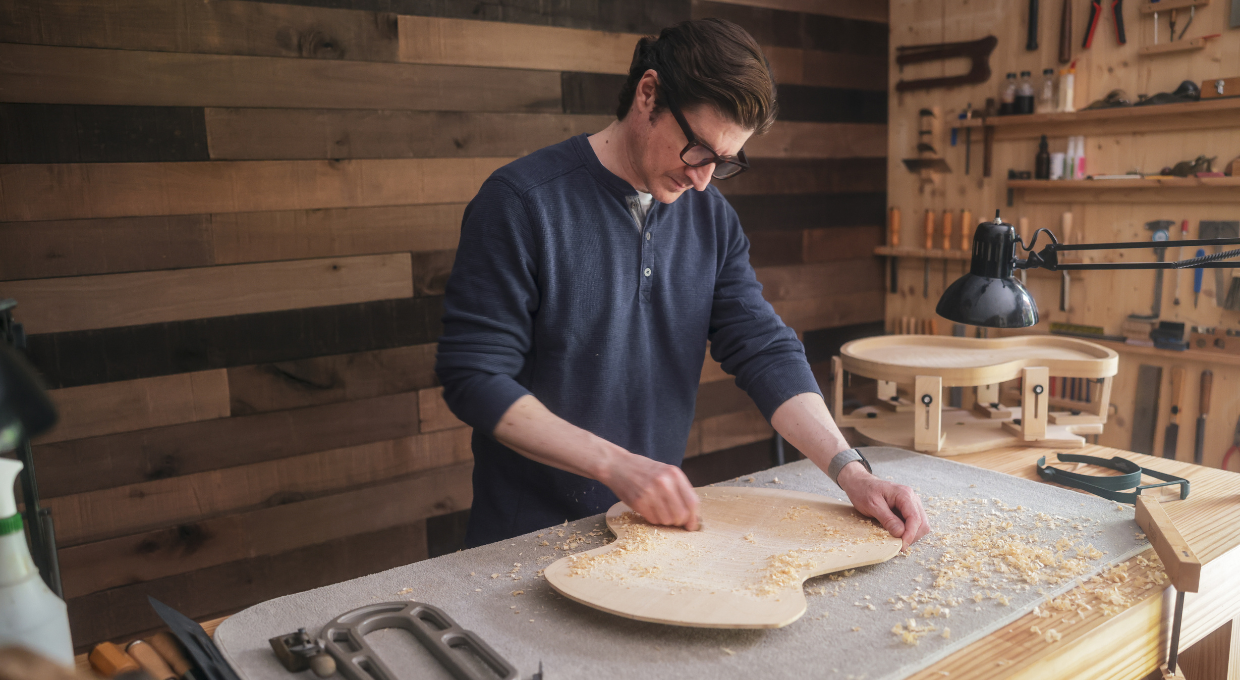
Yesterday I was carving the top of an archtop guitar I’ve been working on, and somewhere in the middle of the work, I caught myself listening.
Not the kind of listening I do all day at the bench, which after almost thirty years just runs underneath everything like breathing. This was different. It was more like watching myself listen, the way you notice you’re in a dream while the dream is still happening.
The wood I’m carving is ancient Sitka spruce. I’ve been holding onto this piece for years, waiting for the right guitar to use it on. Old spruce has a different quality than new spruce. The resins have crystallized. The cell walls have stiffened. It rings out in a way that newer wood, even good newer wood, can’t quite match.
So the carving was loud. Across the grain, with a freshly sharpened plane, this top was on the edge of painfully loud. That kind of loudness is part of why I love this material.
It’s the wood telling you what it can do.
Even unfinished, even still rough on the bench, that top is already built to amplify. Every stroke of my plane was being broadcast into the room by the very piece of wood I was shaping. The plane was cutting. The spruce was singing. The workshop was full of the voice of the wood.
And then I noticed, really noticed, that I was already listening. I’d been listening the whole time. Not trying to. Not analyzing. My body had been making split-second adjustments to the angle of the plane, the pressure, my stance, the rhythm of the stroke, all driven by what I was hearing without any conscious thought in the loop.
I watched my hands carve. I watched my body adjust. And I started hearing, with awareness, what I’m always hearing without paying attention to it.
The workshop was sending the sound back from every direction. Off the little hallway that leads over to my power tool room, one version, with one set of frequencies highlighted by that small reflective space. Off the ceiling above my bench, a different version. Off the wall to my right, where the staircase comes down from upstairs, a third.
I wasn’t just carving a guitar top. I was standing inside a room, listening to it shape the sound around me.
Table Of Contents
Listening Is The Craft
I want to slow down here and say something I think most craft books and most luthiers leave out.
After almost thirty years of building guitars, what I’m more sure of than anything else is this: the listening is the craft. Not part of the craft. Not a technique within the craft. The mastery of lutherie is listening. Everything else flows from it.
I’m always listening.
When I’m carving a top. When I’m tap-tuning a back. When I’m fitting a dovetail and the wood tells me whether the joint is tight or slipping. When a chisel cuts into a brace and the sound tells me about the wood and the sharpness of my edge in a single moment. When a power tool shifts its pitch because I’m feeding too fast. When I walk into any room and my ear maps the space before I’ve taken a step.
Most of the time this runs in the background. Yesterday, for a moment, it came up into the foreground. And I got to watch what I’m actually doing all day, every day.
Underneath all the building, all the choosing, all the carving, I’m just listening.
If you take nothing else from this letter, take this: learn to listen. Everything else will follow.
And one of the most useful places that listening ever took me was hearing the inside of a guitar the way I’d learned to hear any other room.
Bill Porter and the rooms that made records
To understand what I mean, I need to go back about thirty years.
Before I built guitars, I studied audio engineering at Webster University in St. Louis. Double major: audio technology and jazz guitar. Most of my classmates wanted to work in studios. I just wanted to understand sound.
I got to study with a man named Bill Porter, who’s not a household name but probably should be. Bill is one of the great recording engineers of the twentieth century. Elvis. Roy Orbison. The Everly Brothers. He’s in the Audio Engineering Society Hall of Fame. If you’ve heard “Are You Lonesome Tonight?” or “Only the Lonely” or “Crying,” you’ve heard rooms that Bill helped shape.
Sitting in those sessions, I learned something I didn’t know was changing me at the time:
A great recording isn’t about the microphone. It’s about the room. How big it is. How reflective the walls are. Where the sound bounces. The microphone is the last variable. The room is the first.
Bill would walk into a space and hear what it was going to do to a voice or a guitar before anyone played a single note. I sat in those sessions watching him work, and somewhere in there my ear started learning what walls do when they aren’t making any sound of their own.
Years later, when I started building guitars, I kept feeling like I was hearing something I couldn’t put a name to.
Then one day at the bench, it landed.
The inside of a guitar is a room.
The Room Inside The Guitar
Once you hear it, you can’t unhear it. The body of a guitar is an enclosed acoustic space. The top is the speaker. The back and sides are the walls. And just like in any room, what those walls are made of determines what happens to the sound bouncing around inside.
This is where wood choice for back and sides finally makes sense.
Indian rosewood is a reflective room. Dense and stiff. The overtones echo around inside the body before they escape through the sound hole. That’s why a great rosewood guitar feels like the sound is surrounding you. There’s a shimmer, a complexity, a richness in the high end that rewards fingerstyle players especially, where the guitar is the entire texture and the complexity is the point.
Mahogany is a softer room. The high frequencies get gently softened. What comes out is warmer, more direct, more focused on the midrange. For a flatpicker or bluegrass strummer who needs to cut through a band, to be heard above the banjo and the mandolin and the upright bass, that dry punch and focused midrange is exactly what works. The rich overtones of rosewood, beautiful on their own, can actually muddy a band mix by filling up frequency space that other instruments need.
Both are right. They’re different rooms for different music.
Body size is room size. A dreadnought has a lot of air inside, which gives you natural low-end power. A smaller body has less inherent bass weight, so it tends to be more naturally balanced from the start. When I’m choosing wood for a dreadnought, I’m asking myself whether I want reflective rosewood walls to add brightness and balance the low end, or whether I want to lean into warmth with mahogany and let that natural power carry the guitar.
Once you start thinking about it this way, the whole project shifts. You’re not picking from a list.
You’re shaping a space.
How To Start Listening
The next time you walk into any room, your kitchen, your shop, a coffee shop, pause for ten seconds before you do anything else. Just listen. What’s bouncing back? What’s getting absorbed? A hard slap from one wall? A gentle wash of room tone? You don’t need to know the technical names. Just notice what’s there.
Once you start doing this, you can’t stop. Every space you walk into begins to teach you something.
If you want to apply it to wood specifically, try this. Pull up YouTube videos of guitars in the configurations you’re considering. Mahogany dreadnoughts. Rosewood dreadnoughts. The same songs played on each if you can find them. Don’t analyze. Don’t read the comments. Just listen.
After fifteen or twenty minutes, you’ll start noticing patterns. I keep coming back to that one. There’s something about that mahogany sound that pulls me forward. Trust those reactions. They aren’t random. Your ear is doing exactly what mine learned to do in those sessions with Bill, and what it kept developing yesterday at the bench.
That’s where wood choice should start. Not in a spreadsheet. In your ear.
One Last Thing
I didn’t know when I was nineteen that any of those audio classes would matter to my life. I thought I was preparing to work in studios. The same listening turned out to be the foundation of how I hear guitars, how I hear my tools, how I hear every room I walk through.
So if you’ve come to this craft from somewhere unexpected, whether that’s engineering or music or software or woodworking, pay attention to what your past actually taught you. You’re bringing more to the bench than you realize.
The longer I do this, the more I think the room metaphor isn’t really about wood at all. It’s a way of paying attention.
Once you start listening to the room inside the guitar, you start listening to the rooms you walk through, the tools you hold, the woods you carve. And eventually, you start listening to yourself, to your own instincts about what’s right and what isn’t.
The whole craft opens up.
And once it opens, it doesn’t close again.
Sapere Aude · Creare Aude
Tom
P.S. If you want to try this weekend: pause for ten seconds when you walk into your shop and just listen. Or search YouTube for “mahogany vs rosewood acoustic guitar” and sit with a few comparisons. Don’t worry about being right. Just notice what you’re drawn to. That noticing is the beginning of an ear that will serve you for every guitar you ever build.