You’re reading an issue of The Luthier’s Letter. Every Saturday morning I share practical tips, techniques, & lessons from my guitar-building bench to help you grow as a luthier. Join thousands of guitar builders learning the art of lutherie: Subscribe free →
Over fifteen years ago, I got a phone call from a guitar shop in Italy that I’ve never forgotten.
There was a collector over there who owned a huge collection of wonderful guitars, and he had a habit. Every time he bought a new instrument, no matter what it was or who had made it, he took it to this shop to have it scanned and set up on their PLEK machine.
If you haven’t seen one, a PLEK is basically a robot. You strap the guitar in, it scans the fingerboard under string tension with a laser, works out exactly how much to take off each fret, and then does the work to a level of precision no human hand can match. It really is a remarkable thing. And running every new guitar across it was simply what this collector did.So when he got the first guitar I had built for him, he did what he always did. He took it in to be scanned.
And that’s when I got the call.
The guy at the shop wanted to tell me something. He said that of all the guitars he had ever put on that machine, and he did not just mean from this collector, he meant any guitar that had ever come through his shop, mine was the first one that came back needing no work at all.
It was already perfect.
And here’s the really crazy part…
It happened again. The next guitar I built for that collector, a couple of years later, came off the machine the same way. And I am fairly sure the one after that did too. For a while, I just thought of it as a nice surprise. But eventually I sat down and asked myself, honestly, what am I actually doing that would cause that?
And when I really looked at it, I understood.
It comes down to one idea about fretwork that most people never stop to think about.
You can pour a year of your life into a guitar. The tap tone, the bracing, the wood you waited years to use, the finish you fussed over until it was right.
And none of that is the first thing a player feels when they pick the instrument up.
The first thing they feel is whether it is comfortable in their hands, its playability. If it fights them, even a little, they never quite relax into it. Everything you built into that guitar, all the tone and the response and the voice, is sitting right there waiting for them, and they cannot fully reach it, because some part of them is always working around the instrument instead of just playing it.
When the fretwork is right, the opposite happens.
The guitar seems to disappear. The player stops noticing the neck and starts making music.
That is the moment a guitar becomes someone’s favorite.
So here is the thing almost nobody tells you about great fretwork and a great setup. It is not really about how much your neck bows forward.
It is about the shape of that bow.
And it is about how level and even the frets are once the neck holds that shape.
When a string vibrates, it does not move in a straight line. It makes an arc, widest in the middle and tapering down to almost nothing at each end.
Years ago, that picture arrived for me all at once. I was sitting in my car at a stoplight. I looked up and saw the power lines sagging between two poles, and there it was…
That elegant curve is very close to the shape a guitar string takes when in motion. The power line is just holding still long enough for you to see it. (The exact curve shifts slightly depending on where along the string you pluck, but it is always the same basic arc, lowest in the middle and just slightly toward the bridge side.)
A guitar plays beautifully when the forward bow of the neck echoes that arc.
And this is the part that took me years to really understand. It is not only the amount of relief that matters.
It’s where the deepest part of the curve sits.
The string wants the deepest part of the forward bow to fall somewhere around the twelfth to fourteenth fret. On a lot of guitars it does not. Plenty of them actually have a little hump right in that region, which is exactly where you want the neck to be at its lowest point, and it happens because that is a hard spot to control, right where the fingerboard crosses over onto the body.
Once that shape is off, no amount of turning the truss rod will make the guitar feel truly right. You can change how much the neck bows, but you cannot move where the low point falls.
The strings and the player feel that. Even when the player has no idea why the guitar just never sits quite the way they want it to.
That is the insight I wish someone had handed me thirty years ago.
Great playability is not about the amount of bow. It is about matching a shape.
The setup is really built on top of the fretwork, because once the frets are leveled, it is their tops that the strings actually ride on.
Now, there is more than one way to arrive at that shape, and I want to be clear that none of them is wrong. They’re just different roads to the same place.
The PLEK gets there by simulating string tension, working out what the tops of the frets should look like to match the moving string, and then grinding each fret down until they form that arc. Some builders do a version of the same thing by hand, holding the neck in a simulated forward bow while they level, so the frets come out shaped to the curve.
My way is different. And I believe it is the real reason that my guitars beat the machine.
I do not put the curve into the frets at all.
I build it into the neck itself, long before a single fret is ever leveled.
When I glue the fingerboard on, I clamp it over a caul that already has a gentle forward bow shaped into it, the exact shape I want the finished neck to hold, along with a few other small adjustments I walk through in the course. The neck and fingerboard are built and tuned together in that shape, so the very subtle curve is set into the neck’s core from the very beginning.
That curve is the core of it. But it isn’t a single trick. It only works because of the whole system I’ve built around it, the way I cut the slots, size the tangs, and radius the board, every part tuned to hold that one shape together.
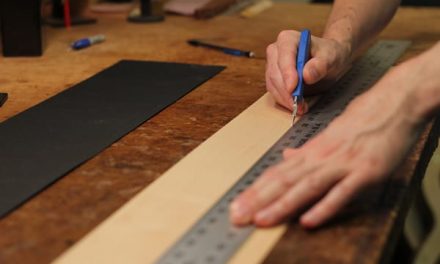
Then, when it is time to level the frets, I straighten the neck out flat with the truss rod and level with a long fret leveling beam.
For me, leveling on that flat surface is the most reliable way I’ve found to get it right. But that is just what works for my hands and my system.
And because the right shape is already living inside the neck, the moment I string the guitar up and let it relax into its very subtle forward bow, it settles into the curve I wanted all along. The low point lands right where it belongs. No hump at the fourteenth fret.
It simply returns to the shape it was made to hold.
The one that harmonizes with the string in motion and creates a neck that feels so good that the player can forget about it altogether.
I have been writing to you about frets for a few weeks now.
Sizing the tang.
Cleaning the slots.
Choosing the wire.
It might have looked like a pile of small, separate details. But this is where they all meet. Every one of them is really about building a neck that can hold the right shape and let the player relax into the music and get lost in the beauty of your guitar and its voice.
So the next time a guitar just does not feel right under your hands, try not to reach straight for the truss rod. Look instead at the shape of the bow, and where its lowest point falls.
That one small shift in how you see it can change everything.
Sapere Aude · Creare Aude
Tom
P.S. Here is one small thing to try this weekend. Pick up a guitar that has just never felt quite right to you, and before you touch a single adjustment, sight down the neck and study the shape of it. Feel where it plays easy and where it fights you, and see if you can find where the lowest point of the bow actually falls. You are not trying to fix anything yet. You are just learning to see the shape. Everything I talked about here begins right there.