You’re reading an issue of The Luthier’s Letter. Every Saturday morning I share practical tips, techniques, & lessons from my guitar-building bench to help you grow as a luthier. Join thousands of guitar builders learning the art of lutherie: Subscribe free →
Before we jump in, I have to take a moment to say thank you. Last week’s letter about the pickup brought in more replies than almost anything I’ve sent in years, and it wasn’t just how many there were. It was the heartfelt stories, the encouragement, and the reminder of what an amazing community this really is. Reading them has been truly inspiring for me. I’m still working my way through them, and I’ve loved every single one.
Last week I told you how I stopped seeing a wooden box and started seeing energy. This week I want to show you what that seeing actually looks like at the bench. It starts with a piece of scrap veneer.
When I taught this in the live Atomic Lutherie sessions, I picked up a thin strip of maple veneer and bent it into a circle. It held, no problem. A clean veneer is surprisingly stable that way, because the tension spreads evenly through the whole curve. No one spot carries more load than any other.
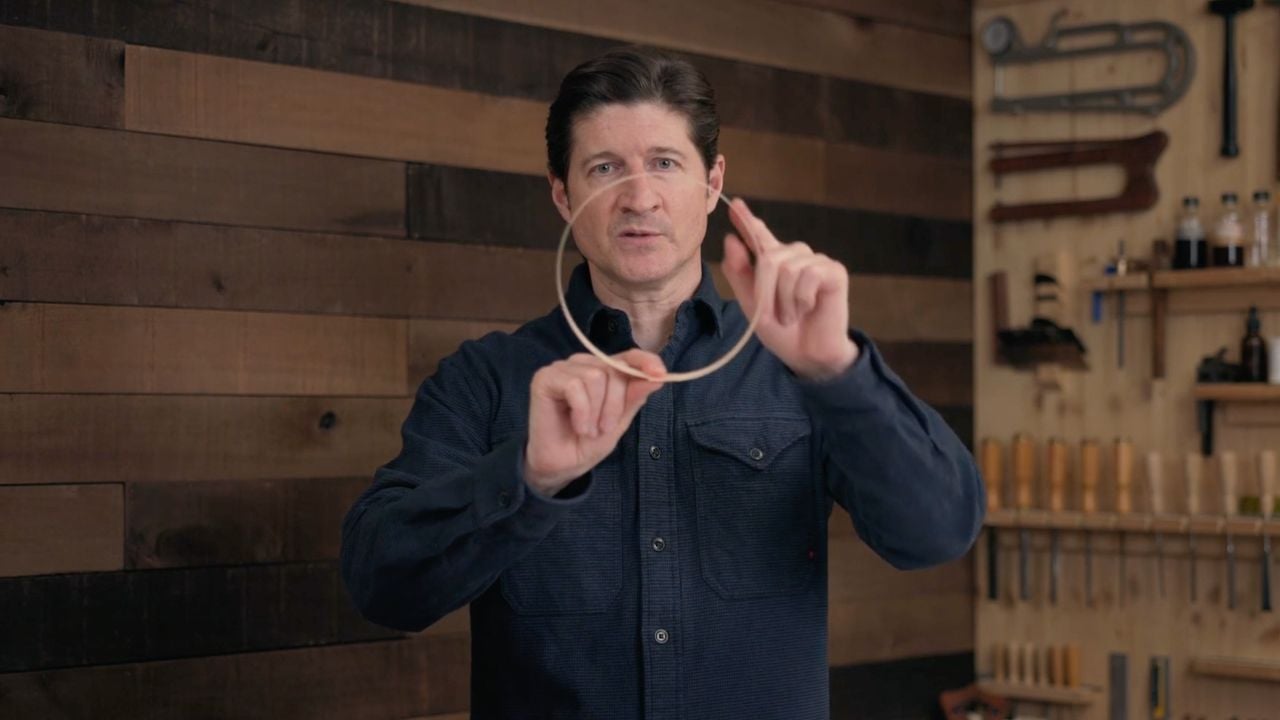
Then I took a blade and put one little scratch across it. Not a cut. A scratch so light that the first time I bent it, the veneer refused to break. I had to laugh, because the exact same thing happened when I taught this in Cremona. This demo likes to humble me. But the stubbornness is really part of the lesson:
Until the energy has somewhere to concentrate, the wood holds.
The second try, it broke right at the scratch. Same piece of wood, under the same pressure.
Energy Always Finds the Low Spot
Here’s what changed. That little scratch gave the energy a place to puddle, to pool. I picture it like water. Tension flows through wood the way water flows through a channel, and when it finds a low spot, it rushes in and gathers there until something gives.
Engineers call it stress concentration. I call it the reason so many guitars fail exactly where they do.
Earlier in that same session, I mentioned that a steel string guitar carries about 160 pounds of string tension. A builder named Rick typed into the chat that his dog weighs 160 pounds and was lying right beside his guitar, so he was looking back and forth between the two of them to get some perspective. I love that. It’s almost as much as I weigh. Picture a big dog (or me) hanging off the neck of your guitar, day and night, never taking a break. All of that force, constantly looking for one little low spot to pool in.
Once you can see that, all that tension, and the way one little flaw invites it to pool, you’ll start seeing it all over the instrument.
For example, if a brace ends in a sharp corner, that corner is like a little dam where stress piles up every time the top flexes. Shape the end of that brace into a long, gentle ramp instead, and the stress flows out along it, spread thin. One small design choice, made once, working for the whole life of the guitar.
Why So Many Guitar Headstocks Break
Or look at a headstock. When a neck is cut from one piece of wood instead of using a scarf joint, the grain runs short right where the headstock angles back. String tension pulls on those short fibers day and night, pooling at the ends of the grain lines, exactly like the stress hunting for that one little scratch in the veneer. That’s why so many headstocks snap clean off. It looks like bad luck. It’s energy finding its “low spot.” And the good news: with the right approach, that vulnerability can be turned into a strength.
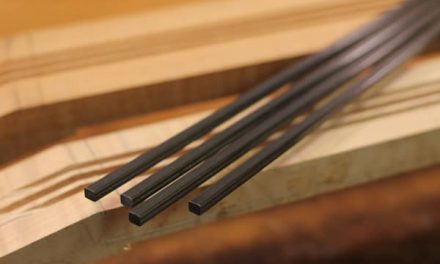
Here’s my favorite part. On my guitars, I glue a backstrap over the back of the headstock. It covers that vulnerable area and continues under the nut toward the first fret, and because it’s built from layers of veneer with the grain running long, right through the danger zone, it acts almost like an I-beam. The stress that used to gather at those grain endings now flows across the strap, spread out evenly.
The headstock gets drastically stronger, the tuning gets more stable, and less energy leaks away from the sound. And as a bonus, the backstrap happens to be one of the most beautiful, elegant details on the whole instrument, in my opinion. You can see what one looks like, and why it works, right here.
The guitar’s most famous weak point becomes one of its strongest and most beautiful features, if we approach it the right way. And if you’d like to add one to your next build, I teach the whole process step by step in The Art of the Guitar Backstrap course, included with a Luthier’s EDGE membership.
That’s the whole Atomic Lutherie way of thinking in one small story.
And notice: that was just the headstock of the guitar, and we only looked at one kind of energy. We didn’t even touch the vibration side of that same joint, where a weak headstock quietly loses string energy that should be going into the sound. Apply this way of seeing to one spot, and you get a real improvement. Apply it across the whole instrument, and the improvements start to multiply. That’s what still gets me excited about this framework, all these years in.
Here’s something to try this week.
If you have a blueprint for your current build, pull it out. If not, just pick up the guitar nearest you and use your imagination. Think about how the string tension is flowing through the design, like water. Sharp corners. Abrupt endings. Short grain. See if you can find one place where the energy could be pooling, the way it did at that scratch in the veneer. You don’t have to fix anything yet.
Just find the spot.
That’s the first step of learning to see the guitar in this new way, and it’s how this way of seeing starts to become your own.
Energy finding the low spot, that one little scratch, is a powerful thing to understand at the bench. And although it might not seem related, this kind of thinking is worth remembering away from the bench, too. In the rest of life, I mean.
Next week I want to talk about why more information doesn’t cure the confusion so many builders are struggling with, and how that confusion might be quietly holding back your growth as a luthier.
Sapere Aude · Creare Aude
Tom