You’re reading an issue of The Luthier’s Letter. Every Saturday morning I share practical tips, techniques, & lessons from my guitar-building bench to help you grow as a luthier. Join thousands of guitar builders learning the art of lutherie: Subscribe free →
Last Saturday I told you about the three backs I lost in one night, and I asked what you’re struggling with and what’s working for you. So many of you wrote back, sharing your struggles and your victories. Thank you so much for that 🙂
Bill, in Central Florida, gave away his humidifiers when he moved down from New England and has since bought a whole new set, because his shop drops into the teens in winter. Gary, near Ottawa, carries five-gallon jugs out to a shop with no water to feed three humidifiers. Richard, a museum conservator for 35 years, told me what happened on my shelf has a name: a microclimate.
And the most common question, from Bill and Randy and more than a few others: My hygrometers don’t agree. Which one do I trust?
I’ll come back to that one, I promise. But first I want to tell you something I share near the beginning of my humidity course, because it’s the deeper reason I felt these letters were so important to share with you in the first place.
If you ask most luthiers about humidity, they’ll tell you something like this:
Keep your shop around 50% humidity at about 72 degrees Fahrenheit, and your wood will settle in around 9% moisture content.
That’s good advice. I give it myself. You can find it in a hundred articles.
And that’s where most people stop.
They’re missing out on a ton.
Because the number is where the subject begins, not where it ends.
When I was learning French polishing, my teacher told me that if I really wanted to master it, I had to understand what shellac was. I didn’t say anything out loud, but in my head I was thinking, I’m not stupid, I know what shellac is. I could have told him about the lac beetle and the tree sap. It took me years of struggling with the work to understand what he actually meant.
Knowing a material isn’t just knowing facts about it. It’s like getting to know a person. It’s more than knowing their name or their history. It goes deeper than logic and words can go.
In guitar making, we need that kind of knowing of our materials to reach our highest potential. It’s knowing how a material behaves, its tendencies, almost its personality, until the understanding moves out of your head and into your hands. Today my senses can feel what the shellac is about to do long before my logical mind is even engaged.
Once that finally clicked with shellac, I understood something else. The best work isn’t only following steps and a formula. At some point the knowledge has to become tacit. You start to feel what the material is doing and respond to it before you’ve put any of it into words. That’s what makes it art, and not just a procedure.
And it made me ask: what if I understood all my materials that way?
The number one material we have to know as guitar makers is wood. We jump right past it into design and physics and the newest tools, and we hardly ever take the time to look closely at the stuff every guitar is made of. Humidity, it turns out, is a doorway to a deeper understanding of this precious material. It’s one way you come to know what wood actually is.
And it is precious. Diamonds and metals are made by geology, and the universe is full of geology. Some planets may even rain diamonds. Wood is made by life. As far as anyone knows, it exists nowhere else, and we get to spend our days working with it.
So let’s look a little closer at what’s actually happening inside the wood.
One of the main things wood did, while the tree was alive, was transport water. It was the tree’s circulatory system. In The Hidden Life of Trees (a fascinating book for wood nerds like us), Peter Wohlleben says a mature beech can move something like 130 gallons of water a day.
So when a piece of spruce on your bench pulls water out of the air, it isn’t misbehaving. It’s doing what it was made to do. Wood loves water. It wants to grab it, and it can’t help itself.
If we zoom way in to the microscopic level, the wood cells have an interesting story to tell.
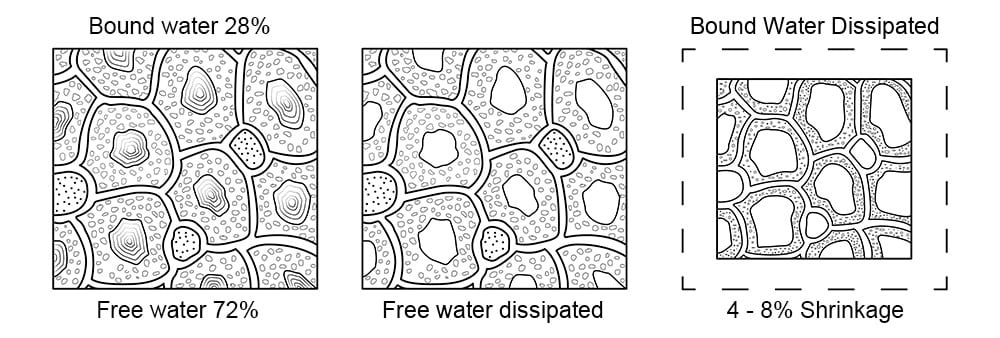
Wood can hold water in two basic ways, and the difference between them matters a lot to us as luthiers. While it’s still green, there’s free water sitting in the open cavities of the cells. That leaves first as the wood dries, and losing it barely changes the wood at all.
By the time a piece of spruce is on your bench, that water is long gone. What’s left is the bound water in the cell walls themselves, and that’s the water the air in your shop is working on. When that water leaves, the walls shrink. When it comes back, they swell. That’s where the dimensional changes we care about begin.
That shrinkage is the force those three backs were fighting that night, and it’s what makes a top rise in August and drop in January. It’s happening in every piece of wood you own, right now, as it searches for a balance with the air around it. It never stops searching. That’s what it’s designed to do.
Here’s the next thing, and it changed the way I look at a guitar. The wood doesn’t move the same amount in every direction. Across the grain one way, it moves a lot. Across the grain the other way, roughly half as much. Along its length, almost not at all.
I don’t get hung up on the exact percentages. What I carry in my head is the proportion, because it’s a framework I can use while I’m working, with my hands busy.
Once you have that framework, you start looking at familiar parts of the guitar differently. Grain orientation. The way a top and back are constructed. Even something as ordinary as putting a water-based glue on a joint you’re making.
There’s a picture that’s been in my head for about 25 years that shows all of this at once. Around 1999 or 2000 I bought a book from the Guild of American Luthiers called Lutherie Woods and Steel String Guitars. I bought it for the write-up on Jimmy D’Aquisto (which is great, by the way), who was and still is one of my heroes. It ended up being the book that first opened my eyes to all of this humidity stuff.
Inside, there’s a simple line drawing and a tip from 1978 that somebody sent in without signing their name. They said to take a scrap of well-seasoned soundboard spruce, a few inches wide and about as thick as a guitar top. Glue a scrap of brace across it on a day when your shop is where you want it to be. Hang it in a corner. When the air dries out, it bends one way. When the air gets wet, it bends the other. How far it bends tells you how far the room has drifted from the day you glued it.
I’ve never made one. But I’ve never forgotten the image. What stayed with me was how much it looked like the basic situation inside a guitar: a thin plate of spruce with a brace running across it. The plate wants to change across its width. The brace running across it changes very little along its length. They’re glued together, so neither one is free anymore, and the whole thing bends.
Everything I just told you about cells and water and grain direction, you can watch happen in that little strip of wood, with no terminology at all.
Now think back to my three backs. They were thin. They were braced. The braces were restraining those plates while the wood itself was trying to change dimension. The hygrometer across the room said 50%. The wood on that shelf was living somewhere else entirely (thanks to Richard, I now know to call it a microclimate).
So, with all that in mind, let’s come back to Bill and Randy’s question: which hygrometer do I trust?
I don’t expect any of them to be perfect. Our tools are something we have to get to know, too, the same way we get to know a material. Set yours side by side for a few days. If one always reads three or four points higher than the rest, now you know that about it. That’s its personality, so to speak. For a proper sanity check, there’s a simple salt test I link to in my humidity guide.
I also keep more than one in the shop, not because I expect them to agree, but to know what’s happening where the wood is stored, where the guitars sit, and where the heat comes in. That lesson cost me three backs. I never forgot it.
I used to hold my shop in a tiny band and worry over every digit. I don’t anymore. I still like to be around 45 to 50% for important glue-ups, but a couple of points either way doesn’t worry me. And when it really matters, I check the wood itself with a moisture meter, because the water in the wood is what I actually care about.
The air is just how I get at it.
After enough years, I pay attention to my senses too. That doesn’t mean I throw out the instruments and trust a feeling. The measurements give me information. Experience tells me what it means.
So maybe the deeper question isn’t which hygrometer is right? It’s what is actually happening in the wood? The hygrometer reading is only one clue. The moisture meter is another.
And the longer you work with wood and really pay attention, the more clues you learn to take in, even the ones you don’t quite have words for. None of that needs perfect instruments. Over time, all of it becomes a deeper knowing. That’s where art and mastery live.
I’ve been thinking I may finally make one of those gauges myself this winter. If any of you have used something like it in your shop, I’d love to hear about it. Just hit reply.
Next week I want to show you what starts to happen when you understand this well enough to work with it, instead of only protecting yourself from it. A glue joint, for instance, that uses the water in the glue to pull itself tight.
That’s where this gets really interesting…
Sapere Aude · Creare Aude
Tom
P.S. There’s only so far I can take something this physical in a letter. Inside my Humidity Fundamentals & Advanced Applications course, I can show you what I’m talking about and go into it in depth: the cells, the two kinds of water, grain direction, the dome, and the advanced applications that changed my guitars. It’s included with the Luthier’s EDGE, where you can bring me questions about your own shop and your own wood as you go.