You’re reading an issue of The Luthier’s Letter. Every Saturday morning I share practical tips, techniques, & lessons from my guitar-building bench to help you grow as a luthier. Join thousands of guitar builders learning the art of lutherie: Subscribe free →
Last Saturday I told you I’d been stuck on my new go-bar deck design for years, and I asked where you were getting stuck. A lot of you wrote back, and your replies are going to shape what we dig into here over the next few weeks, starting today. Reading them reminded me how much we all have in common, and how we’re each finding our way through this craft, one problem at a time.
There were some really great replies, filled with real struggles and frustrations. Trust me, I’ve been there too.
Some of you wrote about more technical things, which we’ll start on next week, but what most of you wrote about came down to being afraid to take the next step.
And that fear often shows up in two main places…
The first is right at the very beginning.
Alan wrote: “I have had all the proper pieces to make a guitar for more than 20 years, but I am too afraid to begin.” And Matt from Connecticut: “I have just one more thing to get done before I really start.”
But some of you got past the start and got stuck later.
You finally made the cut, or glued the top together, and then something went wrong. Randy from Montana has two guitars that need neck resets, and he told me he’s “definitely gun-shy about fixing either of them.”
That second kind happened to me recently, on an archtop top I’m building.
I made a mistake on the center seam. It’s only the second time that’s happened in almost 30 years of building guitars. I didn’t realize the blades on my jointer had gotten chipped and left little ridges. Normally I would have caught that right away, because it’s something I’ve always been on the lookout for. But for whatever reason that day, I still joined it together.
I noticed the issue as I began to carve, but it was one of those borderline things, so subtle that I had to do a sanity check to make sure I wasn’t just being overly perfectionistic. So I kept carving it because I thought it was going to be fine. But I eventually had to accept that it wasn’t up to a level I felt good about using.
Rather than frantically rushing to start over on new wood and redo everything, or letting it completely stop me, I used it as a moment to take a breath, slow down, and look at everything clearly.
And I asked myself if this might be an opportunity to try something new.
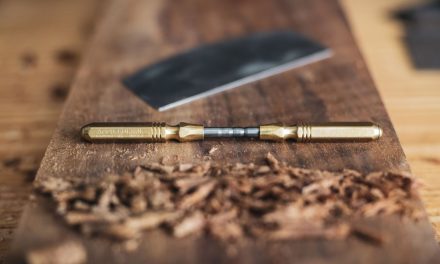
I’d always joined my tops with my grandfather’s old jack plane, or my 6″ Grizzly jointer. But for decades I have been dreaming about getting a special plane just for jointing, and never allowed myself to feel like I had permission to do it. It felt too extravagant.
After all, I’d been making guitars with what I had just fine.
When I finally had time to relax and settle down, I started to see things more clearly about my mistake; I decided it was time to finally allow myself to have something that could potentially change how I join my tops and something that would simply make me happy and fulfill a career-long dream.
So I finally bought my dream jointer plane, a Lie-Nielsen No. 7.
But I didn’t stop there. I decided to let myself play a little, to explore. For the first time in decades, I stopped thinking about the things I want to try and test with plate joining, and I’m actually doing the tests and having some fun.
Like a kid playing with new toys.
Yes, and that’s OK.
In fact, I think it’s necessary sometimes to allow ourselves to experience that. It can open new doors and lead us down new paths and in new directions—even after building for almost 30 years. Maybe it’s more important at that stage than ever.
So, here’s what I’m doing…
I’m joining two archtop sets just as test pieces, fine-tuning my new hand plane and my techniques, testing a couple of new joining methods, and even different glues for the seam. The test plates I’m using are wide enough that I can cut the seam apart and rejoin them if I need to.
So there’s no pressure at all.
I’m actually having a blast. Even after all these years, it’s re-inspired me. And that first top won’t go to waste. I’ll cut the seam apart and rejoin it with whatever I learn, and I’m thankful that mistake happened in the first place.
When something goes wrong at your bench, that’s when you have to step away for a little while. Your nervous system reacts, and it needs time to settle down. I usually go make a coffee or take a walk, and sometimes I wait a couple of days. Then your thoughts can clear, and you start to see opportunities you couldn’t see before.
And even with our best efforts, when we do everything “right,” it might not always go perfectly.
That doesn’t mean we were wrong to try.
I see it like tuning a guitar: you make mistakes in both directions, sharp, then flat, then sharp, then flat, little by little, until you get it right.
That’s part of the learning process.
Or maybe that is the learning process.
Here’s the really cool thing:
That permission to play doesn’t just remove the stress and add pure joy to the process. It’s helping me find out, in real life, if the way I had been working was the best.
It might have been, and that’s an OK result of the experiment too.
But there’s something even better happening: a ripple effect that’s infusing all my work with a renewed joy and lightness.
What if I allowed myself that freedom from now on, and didn’t clamp down again in fear of spending too much money or time, and started building and living this way?
I can’t buy a super expensive tool every month, but I can allow myself the play and the experiments, and the pure joy of exploration and creation. That starts with giving myself permission, valuing the small steps in between, removing the stress, and staying open to learning and growing all the way to the end.
If you haven’t started yet, the same approach works, even before the first cut has ever been made.
A lot of us beat ourselves up because we bought the wood or the tools, and then didn’t start cutting yet.
But even getting those things is starting.
It’s okay.
As I learned with the go-bar deck, we have to allow ourselves to take those steps sometimes, to get things in our hands and in our space so we can feel them and touch them. It seems to help somehow, as we start to move forward.
I think the most dangerous trap is to keep everything in our mind, in the theoretical, trying to figure it out by reading another book or watching more videos.
That’s the quicksand we can get trapped in for years.
Even with all the information out there right now, there’s no substitute for learning with your own hands and ears and heart and body. There may never come a time to begin comfortably if it’s all in your head.
We need to get out of our heads and be there in the space.
If the guitar you want to build feels too intimidating, build a prototype first, with scrap wood. It doesn’t have to be your masterpiece. It just needs to be your teacher. The first cut can come much more naturally when you’ve given yourself enough time with the wood, working on test pieces.
That’s a big part of what the Luthier’s EDGE is about. The Beginner’s Boot Camp takes the pressure off so you can begin, and when something goes wrong partway through, members can bring it to me or to our live Q&A Jam Session each month, and we figure out the next step together.
So here’s something you can try this week.
If you haven’t been in your shop in a while, or you haven’t picked up the wood for your guitar in a while, just go be in the space.
Clean up a little.
Get the wood out and pick your tools back up.
Just be there, and look for one small thing you could play with: test something you’ve been wondering or worrying about on scrap, or draw your guitar full-size to work it out on paper first.
That’s it. No pressure.
I bet you’ll be surprised how much fun it is, and how something so small can start to propel you forward to the next step.
And remember, we’re not just making guitars. It’s a practice that can help us grow as luthiers, for sure, and as people too, but only if we allow ourselves that freedom.
Sapere Aude · Creare Aude
Tom
P.S. Next Saturday, we’ll talk about the guitar neck. A lot of you got stuck there, and several of you asked about it. If the neck is where you’re stuck, and you haven’t already told me, click here and let me know.